How to teach the frog life cycle
Grade 1 to Grade 4
A frog changes shape completely as it grows, a process called metamorphosis. It moves through four stages: frog spawn (eggs), tadpole, froglet, then adult frog. The adult lays eggs and the cycle begins again. Frogs are amphibians, so they start life in water breathing through gills and later live partly on land breathing with lungs.
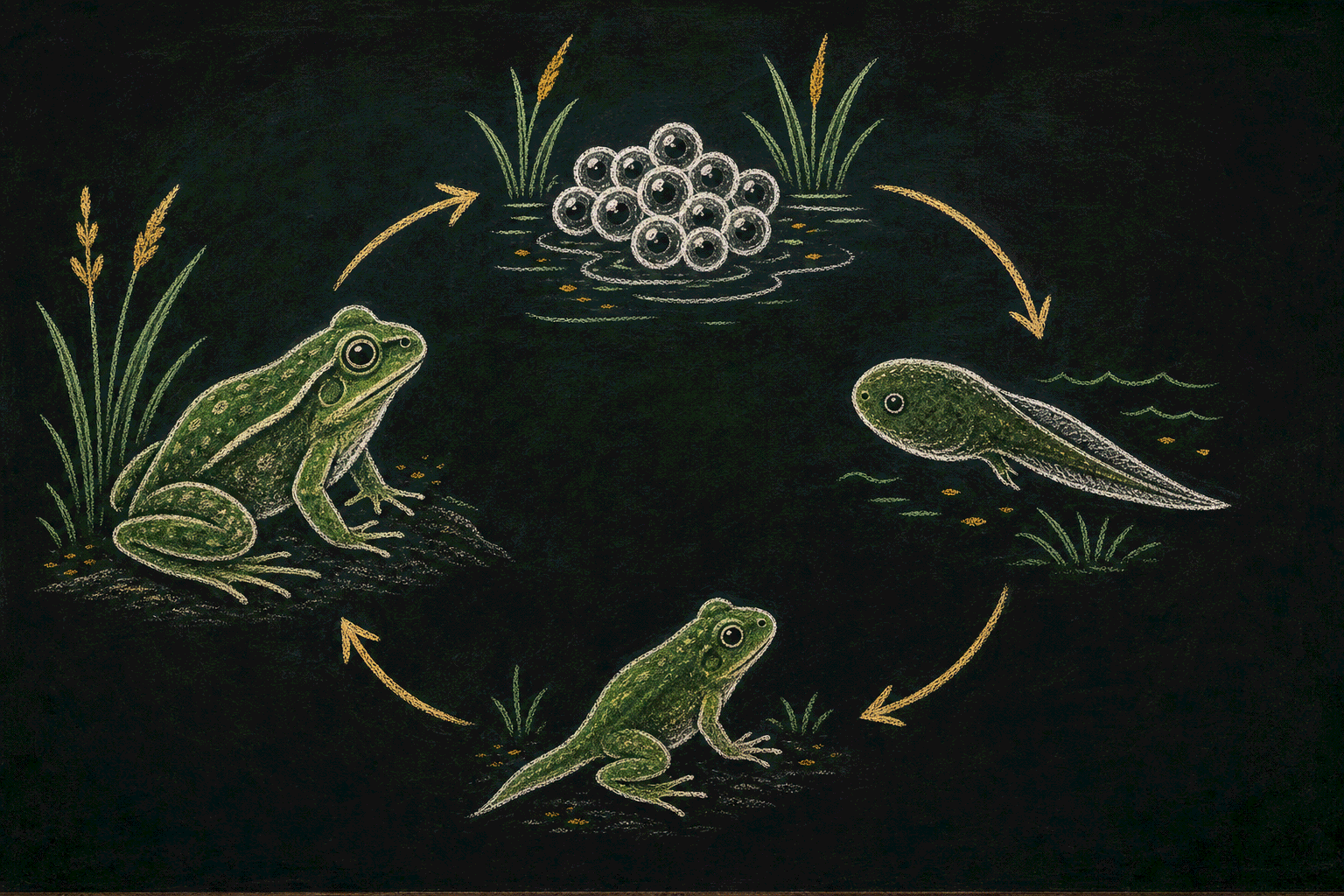
How to teach it
- Introduce the four stages in order with the diagram, and point out how much the body changes at each step (legs grow, the tail shrinks, gills become lungs).
- Connect it to the butterfly life cycle students may already know: both are metamorphosis, a big change of body shape.
- Use the words amphibian, gills and lungs, and explain why a tadpole must stay in water but an adult frog can leave it.
- Have students sequence cut-out stage cards, then label a blank cycle and add an arrow from adult back to eggs to show it repeats.
- If possible, observe real spawn in a tank or watch a time-lapse, then have students describe the change they saw.
Common mistakes
- Getting the stage order wrong (froglet comes after tadpole, not before).
- Thinking a tadpole is a baby fish rather than a young frog.
- Assuming a frog breathes the same way its whole life (gills first, then lungs).
- Forgetting the cycle repeats when the adult lays eggs.
Frequently asked questions
What are the stages of the frog life cycle?
A frog passes through four stages: frog spawn (eggs), tadpole, froglet, then adult frog. The adult lays eggs and the cycle begins again. Along the way the body changes completely, growing legs, losing its tail and swapping gills for lungs.
What is metamorphosis?
Metamorphosis is a complete change of body shape as an animal grows. A frog is a clear example: a legless, tailed, gill-breathing tadpole transforms into a four-legged, lungs-breathing adult frog. Butterflies undergo metamorphosis too, changing from caterpillar to adult.
What age or grade is the frog life cycle taught?
The frog life cycle is usually taught from Grade 1 to Grade 4. Younger students learn the four stages in order and how the body changes, while older students add vocabulary like amphibian, gills and lungs, and compare it with other life cycles such as the butterfly.
Is a tadpole a baby fish?
No. A tadpole is a young frog, not a fish, even though it lives in water and breathes through gills at first. As it grows it develops legs, loses its tail and swaps its gills for lungs, becoming a froglet and then an adult frog that can live on land.
How does a frog breathe at different stages?
A frog does not breathe the same way its whole life. A tadpole lives in water and breathes through gills, like a fish. As it matures into an adult frog it develops lungs and breathes air, which is why the adult can leave the water and live partly on land.
What does it mean that a frog is an amphibian?
Amphibian means an animal that begins life in water and later lives partly on land. A frog fits exactly: it starts as spawn and a tadpole in water breathing through gills, then becomes an adult with lungs that can live on land as well as return to water.
How is the frog life cycle like the butterfly's?
Both are examples of metamorphosis, a big change of body shape as the animal grows. A tadpole becoming a frog mirrors a caterpillar becoming a butterfly: in each case the young animal looks nothing like the adult and transforms dramatically rather than just getting bigger.
Practise with free worksheets
Printable worksheets with answer keys that are never wrong.