How to teach the water cycle
Grade 2 to Grade 5
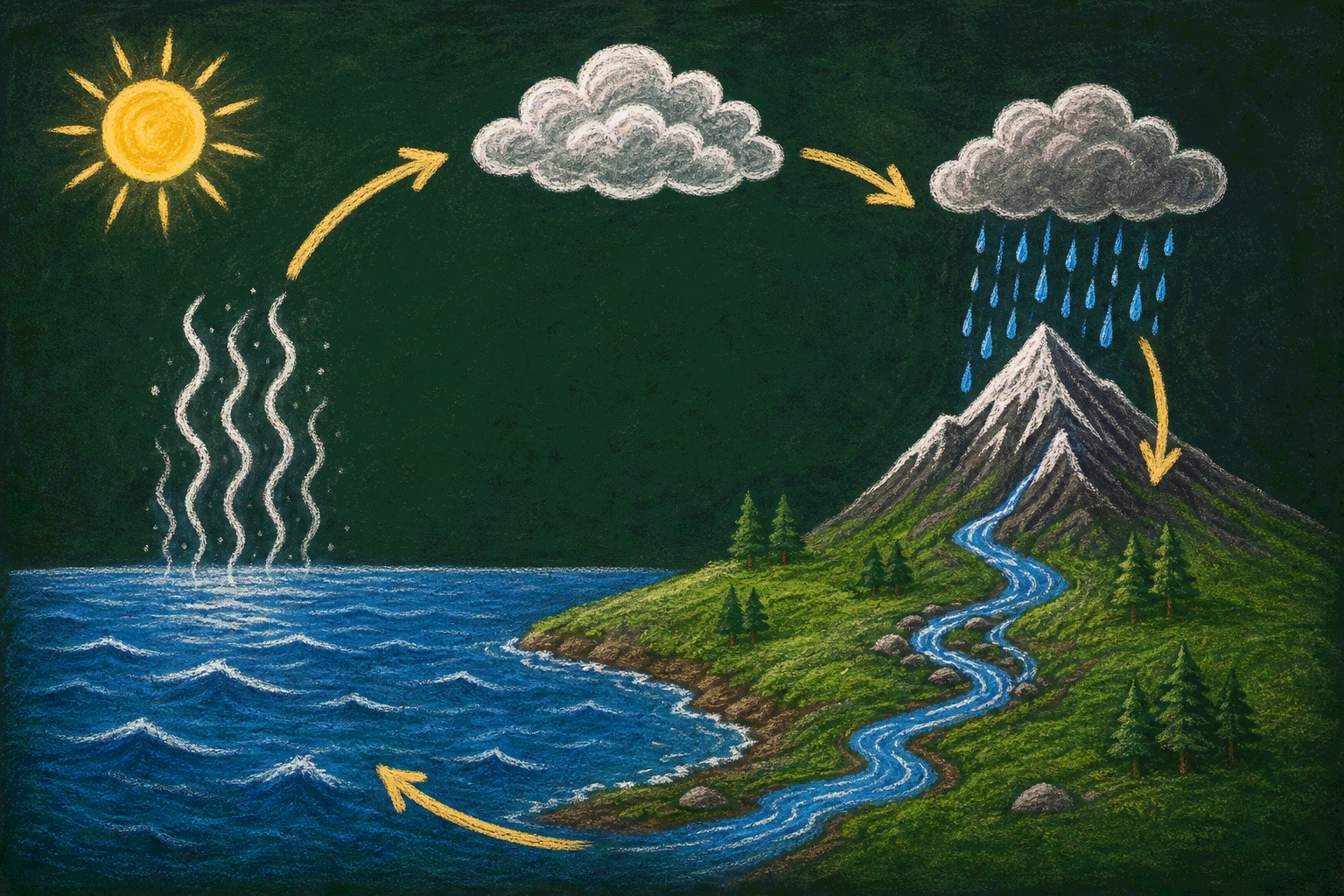
The water cycle is the continuous journey water takes between the sea, the sky and the land. The Sun's heat drives four repeating stages: evaporation, condensation, precipitation and collection. There is no start or end, it just keeps going, which is the key idea for students to grasp.
How to teach it
- Anchor the four words to what students already know: puddles drying (evaporation), a foggy mirror or cold glass 'sweating' (condensation), rain and snow (precipitation), rivers and the sea (collection).
- Use the diagram to trace one drop's whole journey with your finger, sea to sky and back, and stress that it loops forever.
- Do a jar-and-lid demo: warm water in a sealed jar, condensation forms on the lid and 'rains' back down, the whole cycle in miniature.
- Have students label a blank diagram, then explain each arrow to a partner in their own words.
- Extend with where the energy comes from (the Sun) and why the total amount of water on Earth stays about the same.
Common mistakes
- Thinking the cycle has a beginning or an end rather than repeating.
- Mixing up evaporation (liquid to gas) and condensation (gas to liquid).
- Forgetting the Sun is the energy source that drives the whole cycle.
- Believing rain is 'new' water instead of the same water recycled.
Frequently asked questions
What are the four stages of the water cycle?
The four stages are evaporation, condensation, precipitation and collection. The Sun heats water so it evaporates into vapour, the vapour cools and condenses into clouds, the water falls as precipitation like rain or snow, and it collects in rivers, lakes and the sea before the cycle repeats.
What age or grade is the water cycle taught?
The water cycle is usually taught from Grade 2 to Grade 5. Younger students focus on the four stages and everyday examples like puddles drying and rain falling, while older students add the role of the Sun's energy and the idea that Earth's total water stays about the same.
What is the difference between evaporation and condensation?
Evaporation is liquid water turning into invisible water vapour, a gas, when it is heated, such as a puddle drying in the sun. Condensation is the reverse: water vapour cooling back into tiny liquid droplets, such as mist forming on a cold glass. Children often mix the two directions up.
What drives the water cycle?
The Sun is the energy source that drives the whole cycle. Its heat causes evaporation, lifting water into the air as vapour, and the movement of air and the cooling higher up do the rest. Forgetting the Sun's role is a common gap, so it is worth stressing.
Does the water cycle have a beginning or an end?
No. The water cycle is a continuous loop with no start or finish; the same water moves endlessly between the sea, the sky and the land. Thinking it begins or ends somewhere is the most common misconception, so tracing a single drop round and round the diagram helps.
Is rain new water?
No. Rain is the same water recycled, not new water. The water falling today has cycled through evaporation, clouds and rain countless times before. Earth's total amount of water stays roughly constant, which is why the process is a cycle rather than a one-way journey.
What is a simple water cycle demonstration?
Seal some warm water in a clear jar with a lid. The water evaporates, condenses on the cool lid as droplets, and 'rains' back down, showing the whole cycle in miniature. It makes evaporation, condensation and precipitation visible in a few minutes.
Practise with free worksheets
Printable worksheets with answer keys that are never wrong.