Arrays and repeated addition
Rectangular arrays up to 5 by 5, and writing the total as a sum of equal addends
About three lessons of 40 to 55 minutes
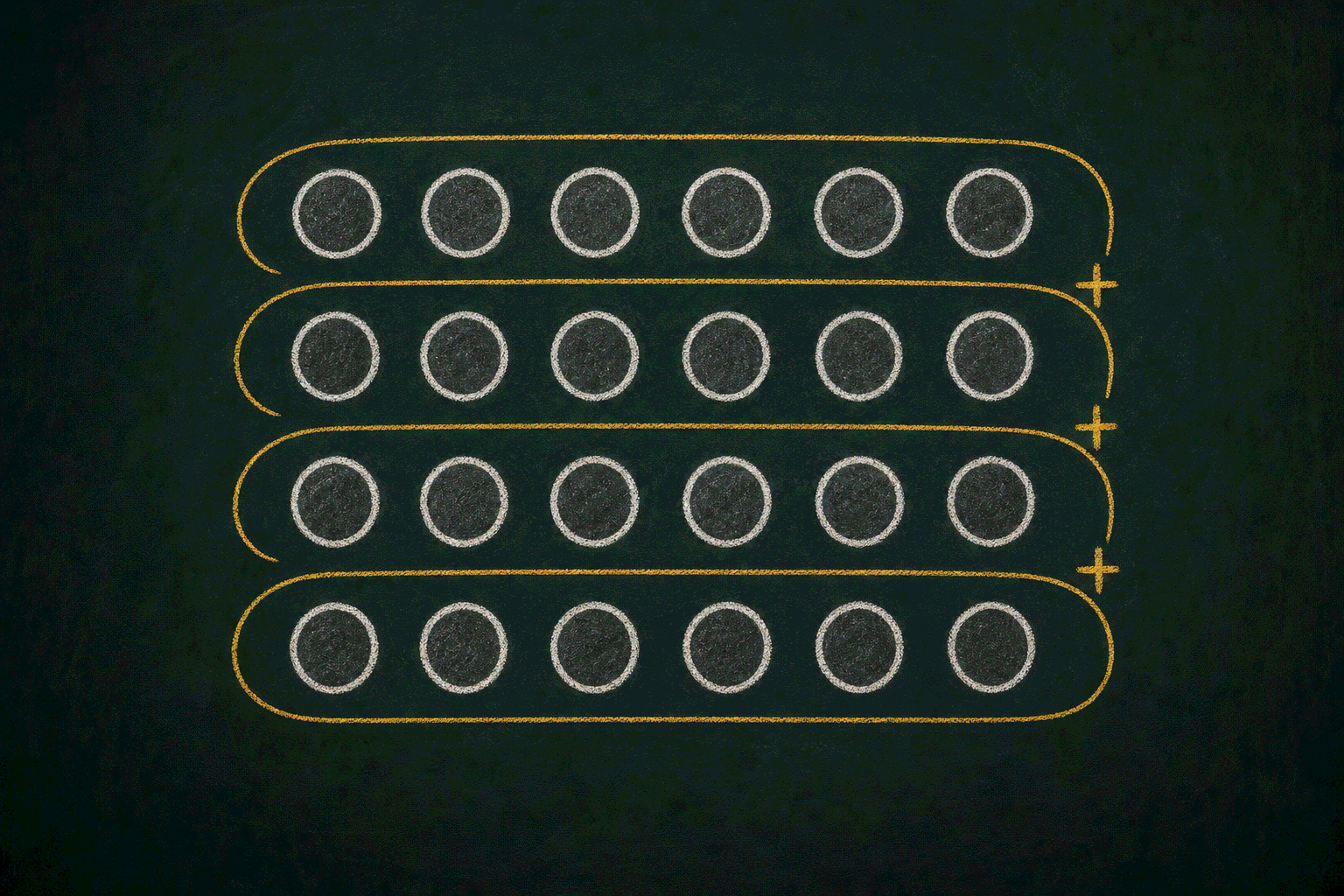
The egg carton already knows the answer
Open an egg carton. The eggs are not scattered, they sit in neat rows: two rows of six, or maybe three rows of four in a smaller box. Because the rows are equal, you do not have to count every egg one at a time. Look at a muffin tray, a box of chocolates, a window with equal panes, the squares on part of a chessboard. Wherever things line up in equal rows and columns, there is a faster way to count them.
That neat arrangement is called an array, and the fast way to total it is repeated addition: adding the same number once for each row. Three rows of four is 4 and 4 and 4, which is 12. Today you will build arrays, count them by adding equal rows, and write the total as an addition of equal numbers. This is the picture that multiplication will grow from next year.
- An egg carton, 2 rows of 66 + 6 = 12 eggs, counted by rows not one by one
- A muffin tray, 3 rows of 44 + 4 + 4 = 12 muffins
- A chocolate box, 4 rows of 55 + 5 + 5 + 5 = 20 chocolates
- A window, 3 rows of 3 panes3 + 3 + 3 = 9 panes
What students will be able to do
Students will arrange objects into rectangular arrays of up to 5 rows and 5 columns, find the total by adding the equal rows (or equal columns), and write the total as an equation that is a sum of equal addends, building the meaning that repeated addition and arrays give to the multiplication they meet in Grade 3.
- I can arrange objects into equal rows and columns to make an array.
- I can count how many are in each row and how many rows there are.
- I can find the total of an array by adding the equal rows.
- I can write the total as a sum of equal addends, such as 4 + 4 + 4 = 12.
- I can add by rows or by columns and get the same total.
Standards this unit teaches
- 2.OA.C.4Common Core (US)Repeated addition with arrays
Use addition to find the total number of objects arranged in rectangular arrays with up to 5 rows and up to 5 columns; write an equation to express the total as a sum of equal addends.
- AC9M2N04Australian Curriculum v9 (ACARA)Repeated addition, equal groups and arrays (Year 2)
Multiply and divide by single-digit numbers using repeated addition, equal groups, arrays and partitioning. This unit builds the array and repeated-addition foundation that descriptor rests on.
- AC9M2N03Australian Curriculum v9 (ACARA)Count collections by making equal groups (Year 2)
Count collections of up to at least 120 by making equal groups and skip counting. Skip counting a row at a time is exactly how students total an array here.
Prior knowledge
This unit builds on skills students should already have met. Revisit any that are shaky first.
- Grade 2 skip counting and patterns teaching unitcounting in equal steps, which is how a row-by-row total is found
- Grade 1 addition and subtraction within 20 teaching unitthe small addition facts used to add the rows
- How to teach skip countingcounting in 2s, 3s, 4s and 5s to total each array
- How to teach additionrepeated addition is adding the same number again and again
- Countingsecure one-to-one counting to check an array total
Words to teach and display
- Array
- objects arranged in equal rows and columns
- Row
- a line of objects going across the array
- Column
- a line of objects going up and down the array
- Repeated addition
- adding the same number once for each equal group
- Equal addends
- the numbers being added when they are all the same, one per row
- Total
- how many there are in all, found by adding every row
Teach it: concrete, pictorial, abstract
The lesson moves from things students can hold, to pictures and diagrams, to the written maths. The diagrams below are drawn from data, so they are accurate and print cleanly. Teach straight from them.
1. Equal rows make an array
ConcreteLay out counters as a muffin tray: 3 rows with 4 counters in each row, lined up so the columns are straight too. This tidy rectangle of equal rows is an array. Because every row holds the same 4, you can total it by adding 4 once for each row: 4 + 4 + 4 = 12. Point along each row as you say it so the class sees one 4 per row.
The key word is equal. If the rows held 4, 3 and 5 you could not add one repeated number, because the rows do not match. An array only works when every row is the same length, and that is what makes repeated addition possible.
Say the array in words the class repeats: 3 rows of 4. The first number is how many rows, the second is how many in each row.
- How many rows are there, and how many counters are in each row?
- Why can we add the same number for every row?
2. Totalling an array as a sum of equal addends
PictorialMove from counters to a drawn array of squares. Here is a 4 by 5 array: 4 rows with 5 squares in each. Total it by adding one 5 for each of the 4 rows: 5 + 5 + 5 + 5 = 20. You can also skip count it, 5, 10, 15, 20, which is the same thing said out loud. The equation 5 + 5 + 5 + 5 = 20 is a sum of equal addends, exactly what this array asks you to write.
There is one addend for each row, and every addend is the size of a row. Four rows of 5 gives four 5s added together. Writing it out makes the equal-groups structure plain.
Skip counting and repeated addition are two names for the same move: 5, 10, 15, 20 is just 5 + 5 + 5 + 5 counted aloud.
Write the total of this 4 by 5 array as a sum of equal addends.
- Count the squares in one row: 5. That is the size of each addend.
- Count the rows: 4. That is how many addends to write.
- Write one 5 per row: 5 + 5 + 5 + 5.
- Add, or skip count in 5s: 5, 10, 15, 20.
Answer: 5 + 5 + 5 + 5 = 20. The array has 20 squares.
- How many addends do you write, and how do you know?
- Skip count this array aloud. What numbers do you say?
3. Add by rows or by columns, same total
PictorialLook at a 3 by 4 array two ways. Add by rows and you have 3 rows of 4: 4 + 4 + 4 = 12. Now add by columns instead: there are 4 columns of 3, which is 3 + 3 + 3 + 3 = 12. Same array, same 12, but two different sums of equal addends. The objects never moved, so the total cannot change.
This is a powerful idea students will use for years: a 3 by 4 array and a 4 by 3 array hold the same number of squares. Turning the page a quarter turn swaps rows and columns without adding or removing a single square.
It also means one array gives you two repeated-addition facts for free. Seeing that 4 + 4 + 4 and 3 + 3 + 3 + 3 both make 12 is the seed of the commutative idea that multiplication will name in Grade 3.
- Write this array as a sum of equal addends by rows, then by columns.
- Did the total change when we added by columns instead of rows? Why not?
4. Build an array from an equation, and split a big one
AbstractNow go the other way. Given the equation 5 + 5 + 5 = 15, build the array: three equal addends means 3 rows, and each addend is 5, so 5 in each row. That is a 3 by 5 array. Reading an equation back into a picture proves you understand what the equal addends mean. And when an array feels big, you can split it into two smaller chunks of rows and add them.
Take a 5 by 4 array (5 rows of 4). Slide a line under the third row to split it into 3 rows and 2 rows. The top chunk is 4 + 4 + 4 = 12 and the bottom chunk is 4 + 4 = 8. Add the chunks: 12 + 8 = 20. You broke a harder count into two easy ones and the total is unchanged.
Splitting keeps everything as repeated addition, just in two friendlier pieces. It is the same array totalled a smarter way, and it previews how bigger multiplications get broken apart later.
Find the total of a 5 by 4 array by splitting it into two chunks of rows.
- The array is 5 rows of 4. Split it after row 3 into a chunk of 3 rows and a chunk of 2 rows.
- Top chunk, 3 rows of 4: 4 + 4 + 4 = 12.
- Bottom chunk, 2 rows of 4: 4 + 4 = 8.
- Add the chunks: 12 + 8 = 20.
Answer: The 5 by 4 array has 20 squares (12 + 8 = 20).
- For 4 + 4 + 4 + 4 = 16, how many rows does the array have and how many in each row?
- When you split an array into two chunks, why does adding the chunks give the same total?
Common misconceptions and how to address them
MisconceptionAdd the number of rows to the number in each row, so a 3 by 4 array is 3 + 4 = 7.
Why it happens: Students add the two numbers that describe the array instead of adding a full row for every row.
How to address it: Point to the array and count all the squares: 12, not 7. The two numbers tell you the size of each addend and how many addends, they are not themselves the thing to add.
MisconceptionThe rows do not have to be equal, so any grid of objects is an array.
Why it happens: Students focus on the rectangle shape and miss that every row must hold the same number.
How to address it: Show a lopsided arrangement with rows of 4, 3 and 5 and ask for the repeated-addition sum. It cannot be written with equal addends, which is why it is not an array.
MisconceptionA 3 by 4 array and a 4 by 3 array have different totals because the numbers are in a different order.
Why it happens: Swapping rows and columns looks like a different problem, so students expect a different answer.
How to address it: Turn one array a quarter turn to land on the other. No square is added or removed, so both total 12. One is 4 + 4 + 4 and the other is 3 + 3 + 3 + 3, but both make 12.
MisconceptionWrite the total as a plain addition of the row sizes even when they differ, like 4 + 3 + 5.
Why it happens: Students copy the repeated-addition format but forget the addends must be equal.
How to address it: Stress that the addends in an array are all the same, one per equal row. If the numbers you are adding are not identical, it is not an array total.
MisconceptionMiscount by tracking objects one by one and losing your place.
Why it happens: Students revert to counting every object instead of using the equal rows.
How to address it: Count by rows: say the running total at the end of each row (4, 8, 12). Skip counting the equal rows is faster and far less error-prone than counting one at a time.
Guided practice (with answers)
1. Write the total of this array as a sum of equal addends.
3 rows of 4: 4 + 4 + 4 = 12. Answer: 4 + 4 + 4 = 12. There are 3 rows of 4.
2. An egg carton has 2 rows of 6. Write the total as repeated addition.
2 rows of 6: 6 + 6 = 12. Answer: 6 + 6 = 12 eggs.
3. Write the total of a 5 by 5 array as a sum of equal addends.
5 rows of 5: 5 + 5 + 5 + 5 + 5 = 25. Answer: 5 + 5 + 5 + 5 + 5 = 25. Five rows of 5.
4. Add this same 3 by 4 array by columns instead of rows.
By columns: 4 columns of 3, so 3 + 3 + 3 + 3 = 12. Answer: 3 + 3 + 3 + 3 = 12. Four columns of 3.
5. The equation is 4 + 4 = 8. How many rows and how many in each row?
Answer: 2 rows of 4 (a 2 by 4 array). Two addends means 2 rows, each addend 4.
6. Find the total of a 4 by 3 array by splitting it into 2 rows and 2 rows.
Answer: 12. Each chunk is 3 + 3 = 6, and 6 + 6 = 12.
Independent practice worksheets
Set the matching ChalkBee worksheets for independent work. The answer keys are computed in code, so they are never wrong. Start with the multiplication sets, which at Grade 2 present equal groups and arrays, and use the skip-counting sets to firm up totalling the rows.
Differentiation
- Keep counters and a small grid mat so students build each array physically before drawing it.
- Give arrays with clearly separated rows and have the student touch and count each row, saying the running total.
- Start with 2 and 5 rows, the easiest to skip count, before 3s and 4s.
- Provide a printed array so the student only has to write the repeated-addition equation, not draw the picture.
- Find every array you can make with exactly 12 squares (1 by 12, 2 by 6, 3 by 4 and their turns) and write each as repeated addition.
- Write both the by-rows and the by-columns equation for the same array and explain why they are equal.
- Split a 5 by 4 array a different way (say 4 rows and 1 row) and show the total is still 20.
- Explain how 4 + 4 + 4 = 12 becomes the multiplication 3 x 4 = 12 that comes in Grade 3.
Assessment: exit ticket
A three-question exit ticket for the last five minutes. It samples reading an array, writing equal addends, and the rows-or-columns idea.
1. Write the total of a 3 by 5 array as a sum of equal addends.
Answer: 5 + 5 + 5 = 15 (or 3 + 3 + 3 + 3 + 3 = 15 by columns).
2. The equation is 4 + 4 + 4 + 4 = 16. How many rows and how many in each row?
Answer: 4 rows of 4, a 4 by 4 array.
3. Does a 2 by 5 array have the same total as a 5 by 2 array? Explain.
Answer: Yes, both are 10. Turning the array swaps rows and columns without changing how many squares there are.
Teacher notes and timings
- Rough timing across three lessons: Lesson 1 building equal rows and reading an array (section 1), Lesson 2 totalling as a sum of equal addends (section 2), Lesson 3 rows-or-columns and building or splitting arrays (sections 3 to 4) plus the exit ticket.
- Stay inside the standard: at Grade 2 the total is written as a sum of equal addends (4 + 4 + 4 = 12), not as a multiplication. Arrays here are capped at 5 rows and 5 columns to match 2.OA.C.4. Name multiplication only as the Grade 3 bridge, in the extension and the closing notes.
- The single biggest error is adding the two array numbers (3 + 4 = 7) instead of adding a full row per row. Keep pointing back to the squares and counting them all to defeat it.
- Adding by rows versus by columns gives two equal-addend equations for the same array. This is the concrete seed of the commutative property, so make it explicit without yet using the word or the multiplication sign.
- US and AU alignment: the US names this exactly at Grade 2 (2.OA.C.4), totalling arrays with repeated addition. ACARA folds arrays, equal groups and repeated addition into Year 2 multiplying and dividing (AC9M2N04) and counting equal groups (AC9M2N03). The array-and-repeated-addition method here serves both and feeds directly into Grade 3 multiplication.
- Use Student view to project this lesson. Print saves the full teacher unit, including answers and teacher notes; use the linked independent-practice worksheets for student handouts.