Understanding division
Sharing equally, making equal groups, and division as the inverse of multiplication
About four lessons of 45 to 60 minutes
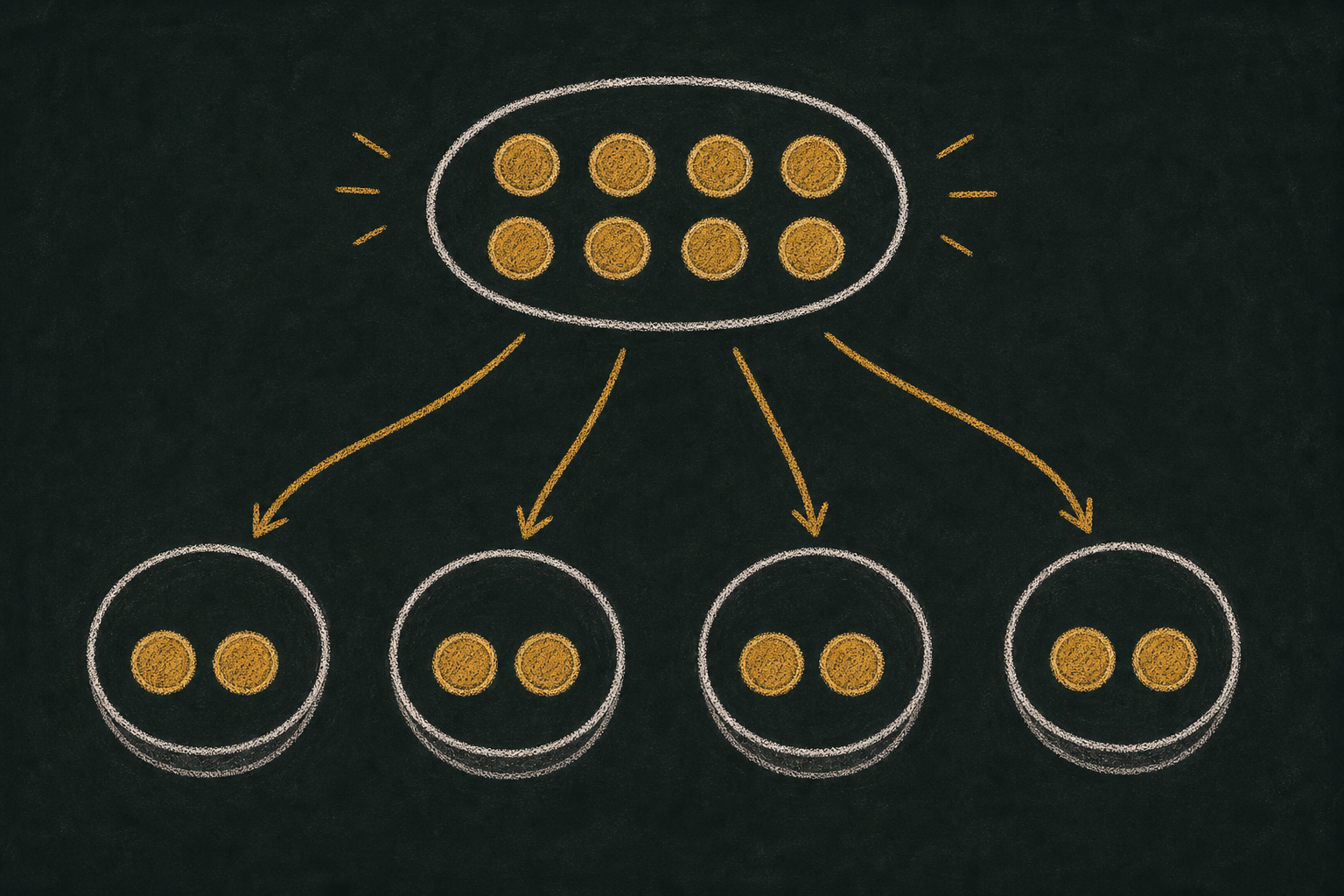
Division is just sharing fairly, the maths way
You divide all the time without calling it that. When you deal a deck of cards so every player gets the same number, when you split a packet of 12 cookies so each of 4 friends gets a fair share, when you sort a pile of socks into pairs, you are dividing. The one rule behind all of it is fair: everyone gets an equal amount, with nothing left over pushed onto one person.
Division answers two everyday questions. Sharing asks how many each: 12 cookies shared among 4 friends is 3 cookies each. Grouping asks how many groups: 12 cookies packed into bags of 4 is 3 bags. Today you will see that both are written 12 divided by 4 = 3, and that every division you meet is a multiplication fact you already know, turned around.
- 12 cookies shared among 4 friends12 divided by 4 = 3 cookies each, a fair share
- 20 cards dealt to 5 players20 divided by 5 = 4 cards each
- 15 players split into teams of 515 divided by 5 = 3 teams, this is grouping
- 10 socks sorted into pairs10 divided by 2 = 5 pairs
What students will be able to do
Students will understand division as sharing a total into equal groups or making equal groups of a given size, write the matching division sentence, connect each division to a known multiplication fact through fact families, and use those facts to divide fluently within 100.
- I can share a total equally and say how many are in each group.
- I can make equal groups of a given size and say how many groups there are.
- I can write a division sentence with a dividend, a divisor and a quotient.
- I can turn a multiplication fact into two division facts.
- I can use a times-table fact I know to work out a division.
Standards this unit teaches
- 3.OA.A.2Common Core (US)Interpret quotients as sharing or grouping
Interpret whole-number quotients of whole numbers, e.g. interpret 56 / 8 as the number of objects in each share when 56 objects are partitioned equally into 8 shares, or as a number of shares when 56 objects are partitioned into equal shares of 8 objects each.
- 3.OA.A.3Common Core (US)Multiplication and division word problems
Use multiplication and division within 100 to solve word problems in situations involving equal groups, arrays and measurement quantities.
- 3.OA.C.7Common Core (US)Fluently divide within 100
Fluently multiply and divide within 100, so that by the end of Grade 3 the related single-digit facts are known from memory. Using a known times-table fact to divide is the route to that fluency.
- AC9M3N04Australian Curriculum v9 (ACARA)Multiply and divide with number sentences and arrays
Multiply and divide one- and two-digit numbers, representing problems using number sentences, diagrams and arrays, and using a variety of calculation strategies.
- AC9M2N06Australian Curriculum v9 (ACARA)Model sharing and grouping (Year 2 foundation)
Model and solve practical problems involving equal sharing and grouping using materials, diagrams and counting. ACARA lays this sharing-and-grouping groundwork at Year 2, which this Grade 3 unit builds into formal division.
Prior knowledge
This unit builds on skills students should already have met. Revisit any that are shaky first.
Words to teach and display
- Divide
- to share a total into equal groups, or make equal groups
- Dividend
- the total you start with and are dividing up
- Divisor
- the number you divide by, the number of groups or the group size
- Quotient
- the answer to a division
- Equal groups
- groups that each hold the same number
- Fact family
- the group of related multiplication and division facts from the same three numbers
Teach it: concrete, pictorial, abstract
The lesson moves from things students can hold, to pictures and diagrams, to the written maths. The diagrams below are drawn from data, so they are accurate and print cleanly. Teach straight from them.
2. Grouping: how many equal groups
ConcreteDivision answers a second question that sounds different but is written the same. Take the same 12 counters, but this time make groups of 4 and see how many groups you can build. You get 3 groups. Write it as 12 divided by 4 = 3. This is the grouping meaning: the total and the size of each group are known, and you are finding the number of groups.
Sharing fixes the number of groups and finds the group size; grouping fixes the group size and finds the number of groups. Both are division, and both use the divide sign. Packing eggs into cartons of 6 or splitting a class into teams of 5 are grouping problems.
There are 20 cookies packed into bags of 5. How many bags?
- The group size is fixed at 5 cookies per bag.
- Count out groups of 5 from the 20 until they run out: 5, 10, 15, 20, that is 4 groups.
- Write it as a division: 20 divided by 5.
Answer: 20 divided by 5 = 4. There are 4 bags.
- How many groups of 2 can you make from 10 counters?
- Is this problem asking how many in each group, or how many groups?
3. Division is multiplication turned around
PictorialHere is the fact that turns division from guessing into knowing. Draw a 3 by 4 array. It shows 3 rows of 4, which is 3 times 4 = 12. That very same array also shows 12 divided by 3 = 4 (share 12 into 3 rows, get 4 in each) and 12 divided by 4 = 3 (make rows of 4, get 3 rows). One picture, four facts.
Those four facts, 3 times 4 = 12, 4 times 3 = 12, 12 divided by 3 = 4 and 12 divided by 4 = 3, are a fact family. Because multiplication and division undo each other, every division you meet is a multiplication fact you already know, read backwards.
- If 3 x 4 = 12, what two division facts do you get for free?
- Which multiplication fact would help you work out 12 divided by 4?
4. Writing division: dividend, divisor and quotient
AbstractNow name the parts of the written sentence. In 12 divided by 3 = 4, the total being divided (12) is the dividend, the number you divide by (3) is the divisor, and the answer (4) is the quotient. Every sharing or grouping situation can be captured in one clean sentence: dividend divided by divisor equals quotient.
Keep tying the symbol back to the picture. If a student writes 18 divided by 3 = 6, ask them to draw the share or the groups that prove it. The written fact and the picture must always agree.
A teacher shares 18 pencils equally among 3 tables. Write a division sentence and solve it.
- The total to share (the dividend) is 18.
- The number of groups (the divisor) is 3 tables.
- Ask the fact family: 3 times what is 18? 3 x 6 = 18, so the quotient is 6.
Answer: 18 divided by 3 = 6. Each table gets 6 pencils. The dividend is 18, the divisor is 3, the quotient is 6.
- Point to the dividend. Point to the divisor. Point to the quotient.
- Read 24 divided by 4 in words two ways.
5. Dividing with the times tables you know
AbstractThe quickest way to divide is to reach for a multiplication fact. To work out 28 divided by 7, do not count out counters, ask instead: 7 times what makes 28? You know 7 times 4 = 28, so 28 divided by 7 = 4. The missing factor is the quotient. This is how the facts become fast.
This missing-factor move works for every exact division at this grade. It also explains dividing by 1 and by the number itself: 6 divided by 1 = 6 (one group of 6), and 6 divided by 6 = 1 (six groups of one). Leftovers, when a number does not share evenly, are met properly in Grade 4 as remainders.
Use a times table to find 24 divided by 6.
- Turn it into a missing-factor question: 6 times what is 24?
- Recall the fact: 6 x 4 = 24.
- The missing factor is the quotient.
Answer: 24 divided by 6 = 4.
- What multiplication fact helps you find 20 divided by 5?
- What is 8 divided by 1, and what is 8 divided by 8?
Common misconceptions and how to address them
MisconceptionDivision can be swapped like multiplication, so 12 divided by 3 is the same as 3 divided by 12.
Why it happens: Multiplication can be done in any order, and students over-apply that to division.
How to address it: Act it out: sharing 12 counters among 3 friends gives 4 each, but sharing 3 counters among 12 friends cannot even give everyone one. Order matters in division, the total goes first.
MisconceptionSharing and grouping are different operations that need different signs.
Why it happens: The two stories sound unlike each other, so students expect two kinds of maths.
How to address it: Show 12 counters solved both ways, share among 3 (4 each) and make groups of 4 (3 groups). Both are written with the divide sign. The sign covers both questions.
MisconceptionDividing by 1 makes a number much smaller, and dividing a number by itself gives that number.
Why it happens: Students expect dividing to always shrink a lot, so the special cases feel wrong.
How to address it: Model it: 6 shared into 1 group is all 6 in that group, so 6 divided by 1 = 6. And 6 shared into 6 groups is 1 each, so 6 divided by 6 = 1. Say each as a sharing story.
MisconceptionEvery number divides evenly, so leftovers can just be ignored or forced into a group.
Why it happens: All the early examples share exactly, so students assume it always works out.
How to address it: Try 13 counters shared among 4: each gets 3 and 1 is left over, it will not share evenly. At this grade, notice and name the leftover; the full method for remainders comes in Grade 4.
MisconceptionTo divide you have to count out counters every time, because it is not really linked to the times tables.
Why it happens: Division is taught with sharing pictures, so the connection to known facts is missed.
How to address it: Turn every division into a missing-factor question: 28 divided by 7 becomes 7 times what is 28. The fact family means the times table you know already holds the answer.
Guided practice (with answers)
1. 12 counters are shared equally among 4 plates. How many on each plate?
Answer: 3. Write it as 12 divided by 4 = 3.
2. Write the division for 18 shared equally among 3 groups.
Answer: 18 divided by 3 = 6.
3. 3 x 5 = 15, so what is 15 divided by 5?
Answer: 3. The fact family turns the multiplication around.
4. How many groups of 2 can you make from 10?
Answer: 5. This is 10 divided by 2 = 5, a grouping question.
5. Use a times table to find 24 divided by 6.
Answer: 4, because 6 x 4 = 24.
6. There are 20 cookies packed into bags of 5. How many bags?
Answer: 4 bags. 20 divided by 5 = 4.
Independent practice worksheets
Set the matching ChalkBee worksheets for independent work. The answer keys are computed in code, so they are never wrong. Start with sharing and grouping, then use the paired multiplication worksheets to strengthen the fact families.
Differentiation
- Stay concrete: keep sharing counters onto plates and building groups before drawing them.
- Limit divisions to the 2s, 5s and 10s first, where the facts are easiest to recall.
- Give a pre-drawn array so the student only reads off the share and the number of groups.
- Provide a multiplication chart so a division can be found by hunting for the known fact.
- Write the full fact family (two multiplications and two divisions) for a set of three numbers.
- Meet leftovers gently: share 13 among 4 and describe the remainder in words.
- Solve two-step problems that multiply then divide, such as buying 3 packs of 6 and sharing among 2.
- Pose a missing-number puzzle: 30 divided by ? = 6, reasoned from a known fact.
Assessment: exit ticket
A three-question exit ticket for the last five minutes. It samples sharing, grouping, and the link to multiplication.
1. Share 16 equally among 4. Write the division and the answer.
Answer: 16 divided by 4 = 4.
2. How many groups of 3 are in 18?
Answer: 6 (18 divided by 3 = 6).
3. If 5 x 4 = 20, what is 20 divided by 5, and why?
Answer: 4, because division turns the multiplication fact around (fact family).
Teacher notes and timings
- Rough timing across four lessons: Lesson 1 sharing and grouping (sections 1 to 2), Lesson 2 the link to multiplication (section 3), Lesson 3 writing division (section 4), Lesson 4 dividing with known facts plus the exit ticket (section 5 and assessment).
- Language to keep saying: share equally, how many in each versus how many groups, dividend, divisor and quotient. Read 12 divided by 3 as a sharing story every time so the meaning stays attached to the symbol.
- Keep counters and grid paper on desks through the pictorial sections. When a division is stuck, hand the student the array and let them share or group it.
- The inverse link to multiplication is also captured in the Common Core as understanding division as an unknown-factor problem (3.OA.B.6); this unit leans on that idea through the fact family without needing the formal name.
- Remainders are deliberately left for Grade 4. At this grade, keep divisions exact and simply notice a leftover when one appears, rather than teaching the remainder method early.
- Use Student view to project this lesson. Print saves the full teacher unit, including answers and teacher notes; use the linked independent-practice worksheets for student handouts.