Multiplication and division fact families
One array, four facts: how multiplication and division are two sides of the same rectangle
About three lessons of 45 to 60 minutes
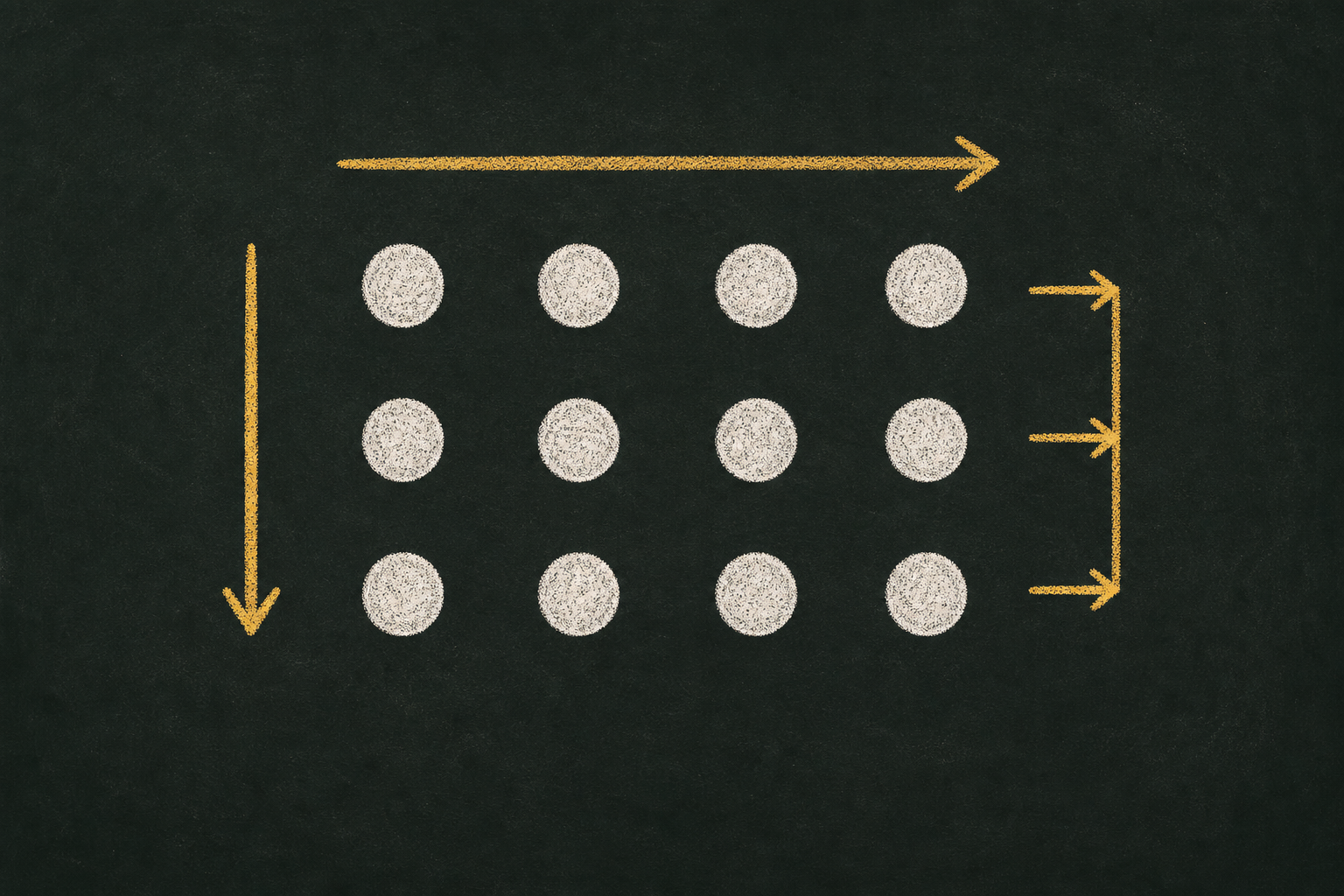
One rectangle, read four ways
Set out 12 counters in a neat rectangle: 4 rows with 3 in each row. A friend looks at the very same counters sideways and sees 3 rows of 4. You both counted 12, and you were both right. That one rectangle is hiding a whole family of facts.
From the three numbers 3, 4 and 12 you can write four true number sentences: two multiplications and two divisions. Learn one and you get the other three almost for free. Today you will see why, using a single array, so that a division fact stops being a separate thing to memorise and becomes a multiplication you already know, turned around.
- A tray of cookies, 4 rows of 34 times 3 is 12, the same tray a friend sees as 3 rows of 4
- 4 times 3 and 3 times 4the order of the factors can swap, the product stays 12
- 12 cookies shared into 4 rows12 divided by 4 is 3 in each row, division reading the same array
- The family for 3, 4 and 12two multiplication facts and two division facts from one rectangle
What students will be able to do
Students will model a product as an array, write the four related multiplication and division facts that share the same three numbers, understand division as finding an unknown factor, and use a known multiplication fact to solve the related division.
- I can build an array and read it as rows times columns.
- I can write the four facts in a multiplication and division fact family.
- I can explain why 4 times 3 and 3 times 4 give the same product.
- I can solve a division by finding the missing factor from a known multiplication.
- I can find the missing number in an equation like 4 times a number equals 12.
Standards this unit teaches
- 3.OA.B.6Common Core (US)Division as an unknown factor
Understand division as an unknown-factor problem, for example find 32 divided by 8 by finding the number that makes 32 when multiplied by 8.
- 3.OA.C.7Common Core (US)Fluently multiply and divide within 100
Fluently multiply and divide within 100, using strategies such as the relationship between multiplication and division, so that single-digit products are known from memory by the end of Grade 3.
- 3.OA.A.4Common Core (US)Find the unknown in an equation
Determine the unknown whole number in a multiplication or division equation relating three whole numbers, for example find the number that makes the equation 8 times a number equals 48 true.
- AC9M3A02Australian Curriculum v9 (ACARA)Facts for 3, 4, 5 and 10, and related division facts
Recall and demonstrate proficiency with multiplication facts for threes, fours, fives and tens, and recognise the related division facts.
- AC9M3N04Australian Curriculum v9 (ACARA)Multiply and divide with arrays and number sentences
Multiply and divide one- and two-digit numbers, representing problems using number sentences, diagrams and arrays, and using the relationship between multiplication and division.
Prior knowledge
This unit builds on skills students should already have met. Revisit any that are shaky first.
Words to teach and display
- Factor
- one of the two numbers being multiplied, or the number of rows or columns
- Product
- the answer to a multiplication, the total in the array
- Array
- objects arranged in equal rows and columns
- Quotient
- the answer to a division
- Fact family
- the set of related facts you can make from the same three numbers
- Inverse
- the operation that undoes another, division undoes multiplication
Teach it: concrete, pictorial, abstract
The lesson moves from things students can hold, to pictures and diagrams, to the written maths. The diagrams below are drawn from data, so they are accurate and print cleanly. Teach straight from them.
1. One array, two multiplication facts
ConcreteBuild the array in front of the class: 4 rows of 3 counters. Count the total, 12. Now turn the whole array a quarter turn. Nothing was added or taken away, but now it reads as 3 rows of 4, still 12. The same rectangle gives two multiplication facts.
4 rows of 3 is written 4 times 3 equals 12. Read the same counters as 3 rows of 4 and it is 3 times 4 equals 12. Because the total does not change when you turn the array, the order of the two factors can swap without changing the product. That is the commutative property, and it means every multiplication fact comes as a matching pair.
This pairing is the first half of the fact family. The two factors are 4 and 3, and the product is 12, in both facts.
- If I build 5 rows of 2, what two multiplication facts does the array give?
- Why does turning the array not change the total?
2. The same array, two division facts
PictorialDivision is the same array read backward. Instead of starting with the rows and columns and asking for the total, start with the total (12) and one of the numbers, and ask for the other. That is exactly what the rectangle shows.
Take the 12 counters and share them into 4 equal rows: how many in each row? Three. That is 12 divided by 4 equals 3. Now share the 12 into 3 equal rows instead: four in each. That is 12 divided by 3 equals 4.
So the one array of 12 gives four facts in all: 4 times 3 equals 12, 3 times 4 equals 12, 12 divided by 4 equals 3, and 12 divided by 3 equals 4. The product 12 is the whole. The factors 3 and 4 are its two parts. Multiplication puts the parts together, division pulls one part back out.
Write the whole fact family for 3, 4 and 12.
- Two multiplications from the array: 4 times 3 equals 12, and 3 times 4 equals 12.
- Two divisions from the same array: 12 divided by 4 equals 3, and 12 divided by 3 equals 4.
- The product 12 is the whole, and 3 and 4 are the two factors.
Answer: 4 x 3 = 12, 3 x 4 = 12, 12 / 4 = 3, 12 / 3 = 4.
- In 12 divided by 4 equals 3, which number is the whole array total?
- How is 12 divided by 3 different from 12 divided by 4 on the same array?
3. Division is a missing-factor puzzle
AbstractHere is why fact families make division easier: every division is really a multiplication with a gap in it. To work out 12 divided by 4, you do not count out counters, you ask what times 4 gives 12. You already know 4 times 3 is 12, so the answer is 3.
Write the division as an equation with a missing factor: 4 times (a number) equals 12. Fill the gap using a times-table fact you know. This is why fluent times tables make division fast: the division answer is hiding inside a multiplication you have already learned.
It works for any family. For 6, 4 and 24: to find 24 divided by 6, ask 6 times what equals 24. Since 6 times 4 is 24, the answer is 4.
Use a known multiplication to find 24 divided by 6.
- Rewrite as a missing factor: 6 times (a number) equals 24.
- Recall the times-table fact: 6 times 4 equals 24.
- So the missing factor, and the quotient, is 4.
Answer: 24 divided by 6 is 4, because 6 times 4 is 24.
- Turn 15 divided by 5 into a missing-factor question, then answer it.
- Which multiplication fact helps you find 20 divided by 4?
Common misconceptions and how to address them
MisconceptionDivision can be turned around like multiplication, so 12 divided by 3 is the same as 3 divided by 12.
Why it happens: Students learn that 3 times 4 equals 4 times 3 and over-apply the swap to division.
How to address it: Show the array: 12 divided by 3 shares 12 counters into 3 rows and gives 4 each, but 3 divided by 12 shares only 3 counters into 12 rows, which is less than one each. Multiplication can swap its factors, division cannot swap the whole and a part.
MisconceptionA fact family has only two facts (the two multiplications, or one of each), not four.
Why it happens: Students stop once they have written the facts that feel most familiar.
How to address it: Always draw the array first and read all four sentences off it: two multiplications and two divisions. Count them out loud, one, two, three, four.
MisconceptionAny of the three numbers can be the product, so 3 divided by 12 or 4 divided by 12 belongs in the family.
Why it happens: The three numbers get treated as interchangeable, without noticing that the largest is the whole.
How to address it: Name the whole: the product 12 is the total of the array and is always the number you divide into, never the number you divide by. The two smaller numbers are the factors.
Misconception4 times 3 and 3 times 4 are different problems with different answers.
Why it happens: The two look like separate facts, so students learn each from scratch and miss that they pair up.
How to address it: Turn the same array a quarter turn: the counters do not change, so the product cannot change. Learning one fact of the pair gives the other at once.
MisconceptionTo divide, the bigger number just always goes first, with no reason why.
Why it happens: Students notice the pattern (you write the large number first in a division) but treat it as an arbitrary rule.
How to address it: Give the reason: the bigger number is the product, the whole array total, and division starts from the whole to find a missing part. The rule follows from meaning, it is not a rule for its own sake.
Guided practice (with answers)
1. Write the four facts in the family for 2, 5 and 10.
Answer: 5 x 2 = 10, 2 x 5 = 10, 10 / 5 = 2, 10 / 2 = 5.
2. The array below has 6 rows of 4. Write one multiplication and one division it shows.
Answer: 6 x 4 = 24 and 24 / 6 = 4 (also 4 x 6 = 24 and 24 / 4 = 6).
3. Fill the gap: 4 times __ equals 12. What division does this answer?
Answer: 4 times 3 equals 12, so 12 divided by 4 is 3.
4. Find 18 divided by 3 using a multiplication fact.
Answer: 6. Ask 3 times what is 18, and 3 times 6 is 18.
5. Which fact does not belong in the family for 3, 4 and 12: 12 / 4 = 3, 3 x 4 = 12, or 12 / 5 = 3?
Answer: 12 / 5 = 3 does not belong (it is not even true, and 5 is not one of the family's numbers).
6. True or false: 20 divided by 5 is the same as 5 divided by 20.
Answer: False. 20 divided by 5 is 4, but 5 divided by 20 is less than one. Division does not swap the whole and a part.
Independent practice worksheets
Set the matching ChalkBee worksheets for independent work. The answer keys are computed in code, so they are never wrong. Start with writing full fact families, then move to using them to solve divisions.
Differentiation
- Keep counters on the desk so every fact family can be built as an array and turned by hand.
- Start with small, familiar families (2, 5, 10) where the multiplication facts are already known.
- Give a partly written family (the array and two facts) so the student only fills the missing two.
- Colour the rows one way and the columns another so the two ways of reading the same array stay visible.
- Explore square-number families such as 4, 4 and 16, where two of the four facts look the same, and explain why.
- Write missing-number problems for a partner, such as (a number) divided by 6 equals 4, and swap.
- Extend to two-digit products, such as the family for 7, 8 and 56, and check with an array sketch.
- Connect back to addition and subtraction fact families and describe what is the same and what is different.
Assessment: exit ticket
A three-question exit ticket for the last five minutes. It samples writing a family, using a fact to divide, and the reasoning that division does not swap.
1. Write the four facts in the family for 3, 6 and 18.
Answer: 6 x 3 = 18, 3 x 6 = 18, 18 / 6 = 3, 18 / 3 = 6.
2. Use a multiplication fact to find 28 divided by 4.
Answer: 7, because 4 times 7 is 28.
3. Is 16 divided by 2 the same as 2 divided by 16? Explain.
Answer: No. 16 divided by 2 is 8, but 2 divided by 16 is less than one. Division does not swap the whole and a part.
Teacher notes and timings
- Rough timing across three lessons: Lesson 1 the two multiplication facts from one array (section 1), Lesson 2 the two division facts and writing the full family (section 2), Lesson 3 division as a missing factor plus the exit ticket (section 3 and assessment).
- Keep one physical array on show the whole unit. When a student is unsure which division a family gives, hand them the counters and have them share the total into rows.
- Language to keep saying: the product is the whole, the factors are the parts. This one phrase heads off putting the wrong number as the product and the divide-the-bigger-first confusion.
- The arrays use dots rather than squares so counters can be shared into rows by eye. Every array total is exactly rows times columns, drawn by the code, so what students count always matches the fact.
- This is the multiplication and division version of a fact family. Students first met the idea with addition and subtraction, so link back to it explicitly (the /learn/fact-families guide covers both).
- US and AU alignment: the US pins division to multiplication through the unknown-factor idea (3.OA.B.6) and equation-solving (3.OA.A.4), reaching fluency within 100 (3.OA.C.7). ACARA Year 3 asks for the multiplication facts for 3, 4, 5 and 10 with the related division facts (AC9M3A02) and array and number-sentence representations (AC9M3N04). The two frameworks align closely at this grade.
- Use Student view to project this lesson. Print saves the full teacher unit, including answers and teacher notes; use the linked independent-practice worksheets for student handouts.