Multiplying by the area (box) method
Two-digit by one-digit multiplication using place value and partial products
About four lessons of 45 to 60 minutes
Big numbers are just tens and ones in disguise
You already know 4 x 3 = 12. So what makes 4 x 13 look scary? Nothing, once you see the trick: 13 is just 10 and 3 stuck together. Split it back apart and the hard question becomes two easy ones you can already do, 4 x 10 and 4 x 3, added together.
That is the whole idea of the area or box method. You break the two-digit number into its tens and its ones, multiply each piece on its own, then add the pieces back up. Today you will turn any two-digit times one-digit into a picture you can see and a sum you can trust, and you will learn why the written method your teacher uses is really this same picture folded up small.
- 4 boxes of 13 chocolates4 x 13, split as 4 x 10 = 40 and 4 x 3 = 12, so 40 + 12 = 52
- 6 rows of 24 chairs in a hall6 x 24, split as 6 x 20 = 120 and 6 x 4 = 24, so 120 + 24 = 144
- 7 cartons holding 36 eggs7 x 36, split as 7 x 30 = 210 and 7 x 6 = 42, so 210 + 42 = 252
- 3 people each saving $453 x 45, split as 3 x 40 = 120 and 3 x 5 = 15, so 120 + 15 = 135
What students will be able to do
Students will multiply a two-digit number by a one-digit number by partitioning the two-digit number into tens and ones, finding each partial product from place value, adding the partial products to get the total, and connecting this area (box) method to the standard written algorithm.
- I can split a two-digit number into its tens and its ones.
- I can multiply a one-digit number by a multiple of ten, such as 4 x 20.
- I can draw a box (area model) and fill in each partial product.
- I can add the partial products to find the total.
- I can explain how the box method matches the written column method.
Standards this unit teaches
- 4.NBT.B.5Common Core (US)Multiply using place value and area models
Multiply a whole number of up to four digits by a one-digit whole number using strategies based on place value and the properties of operations. Illustrate and explain the calculation by using equations, rectangular arrays, and area models.
- 3.NBT.A.3Common Core (US)Multiply by multiples of ten (foundation)
Multiply one-digit whole numbers by multiples of 10 in the range 10 to 90, such as 9 x 80, using strategies based on place value. This is exactly the tens partial product the box method depends on, so it is the Grade 3 foundation this unit builds on.
- 3.OA.C.7Common Core (US)Single-digit fact fluency (foundation)
Fluently multiply within 100, knowing the single-digit products from memory. Each box in the area model is a single-digit fact, so this fluency is what makes the method quick rather than slow.
- AC9M4N05Australian Curriculum v9 (ACARA)Efficient multiplication strategies
Develop efficient mental and written strategies, and use appropriate digital tools, for solving problems involving multiplication of larger numbers by one-digit numbers. Partitioning into place-value parts is one of these strategies.
- AC9M4A02Australian Curriculum v9 (ACARA)Multiplication facts to 10 x 10
Recall and demonstrate proficiency with multiplication facts up to 10 x 10, and the related division facts, extending and applying these facts. These are the facts each box in the model calls on.
Prior knowledge
This unit builds on skills students should already have met. Revisit any that are shaky first.
Words to teach and display
- Factor
- a number being multiplied
- Product
- the answer to a multiplication
- Partial product
- the answer to one piece of the multiplication, such as 4 x 10 = 40
- Partition
- to split a number into parts, here into its tens and its ones
- Place value
- the value a digit has because of its position, so the 2 in 24 means 20
- Area model
- a rectangle split into boxes that shows each partial product as an area
Teach it: concrete, pictorial, abstract
The lesson moves from things students can hold, to pictures and diagrams, to the written maths. The diagrams below are drawn from data, so they are accurate and print cleanly. Teach straight from them.
1. Split the number into tens and ones
ConcreteEverything in this unit rests on one move you already know from place value: a two-digit number is a bunch of tens and a few ones. Build 24 with base-ten blocks: 2 ten-rods and 4 unit-cubes. Say it out loud as the class repeats: 24 is 20 and 4. Write 24 = 20 + 4. Do a few more (37 = 30 + 7, 45 = 40 + 5) until the split is automatic.
This split is the key that unlocks big multiplications. The tens part (the 20) and the ones part (the 4) get multiplied separately, then added. If a student cannot yet partition a two-digit number confidently, stay here with the blocks before moving on.
The bar below shows 24 broken into its 20 and its 4. Notice the tens part is much longer: it carries most of the value.
- Split 36 into tens and ones.
- In the number 58, what is the 5 really worth?
2. Multiplying by a multiple of ten
ConcreteBefore the full method, master its harder half: multiplying by a multiple of ten. To find 4 x 20, think of it as 4 groups of 2 tens. That is 8 tens, which is 80. The shortcut students discover is do the easy fact 4 x 2 = 8, then attach the ten by adding a zero: 4 x 20 = 80.
Anchor the shortcut to meaning so it is never a blind trick. 4 x 20 is four jumps of twenty along the number line, landing on 80. The zero is there because we counted in tens, not ones.
Find 6 x 20.
- Do the easy fact first: 6 x 2 = 12.
- You were really multiplying by 2 tens, so the answer is 12 tens.
- 12 tens is 120.
Answer: 6 x 20 = 120.
- What is 3 x 40, and which easy fact did you use?
- Why does 5 x 30 end in a zero?
3. The area model: one picture, two partial products
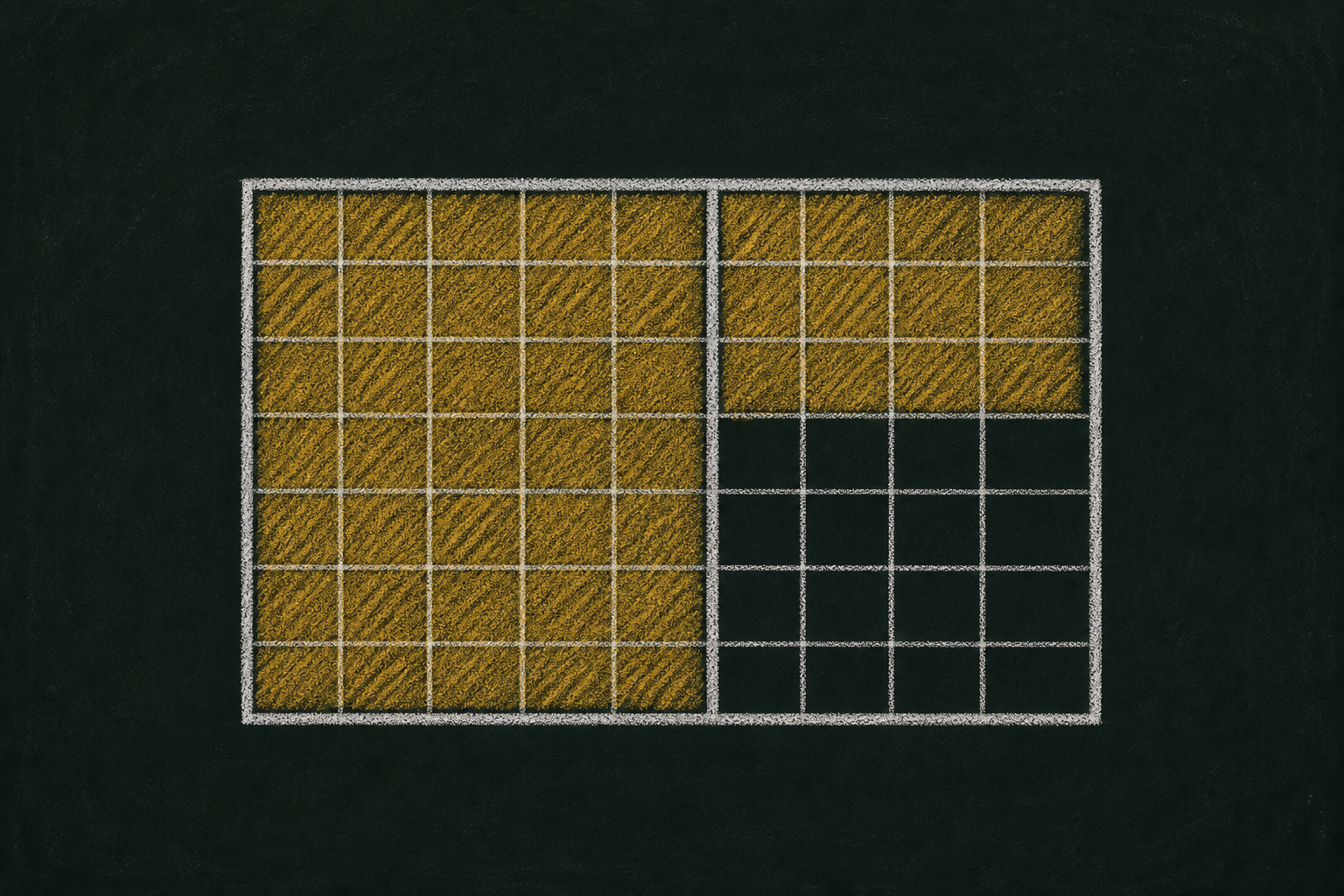
PictorialNow put the two halves together in a picture. To find 4 x 13, draw a rectangle 4 rows tall and 13 columns wide. Slide a line to break the 13 into 10 and 3. The rectangle is now two boxes: a 4 by 10 box and a 4 by 3 box. Each box is a partial product you can count: 4 x 10 = 40 and 4 x 3 = 12. Add the two areas: 40 + 12 = 52. So 4 x 13 = 52.
This is the distributive property made visible: 4 x 13 = (4 x 10) + (4 x 3). The whole rectangle is the whole product, and the two boxes are the two easy pieces it splits into. It is the same break-apart move from Grade 3 multiplication, now used for a two-digit number.
Use the area model to find 3 x 14.
- Split 14 into 10 and 4.
- First box: 3 x 10 = 30.
- Second box: 3 x 4 = 12.
- Add the partial products: 30 + 12 = 42.
Answer: 3 x 14 = 42.
- In the 4 by 13 picture, which box is the bigger area, and why?
- What two partial products would you get for 5 x 12?
4. The box method for larger numbers
PictorialWhen the tens get too many to draw every square, keep the boxes but stop drawing individual cells. Draw a simple two-cell box, write the tens and ones along the top and the single-digit factor down the side, and fill each cell with its partial product. For 6 x 24: split 24 into 20 and 4, so the cells are 6 x 20 = 120 and 6 x 4 = 24. Add them: 120 + 24 = 144.
The bar below shows the two partial products, 120 and 24, joining to make the whole answer 144. The box method never changes: partition, multiply each part, add the parts. It scales to any two-digit number without needing to count squares.
Use the box method to find 5 x 23.
- Partition 23 into 20 and 3.
- First cell: 5 x 20 = 100.
- Second cell: 5 x 3 = 15.
- Add the partial products: 100 + 15 = 115.
Answer: 5 x 23 = 115.
- What are the two partial products for 4 x 26?
- Why can we still use boxes even when we do not draw every square?
5. From the box to the written method
AbstractThe standard written method is the box method folded up. Take 7 x 36. The box gives 7 x 30 = 210 and 7 x 6 = 42. In the column method you write 36, put 7 underneath, and do the same two multiplications: 7 x 6 = 42 (write the 2, carry the 4) and 7 x 30 = 210, then combine to 252. Same two partial products, same total, just arranged in columns.
Showing both side by side stops the written method from feeling like a set of magic rules. The carry is just the extra ten from the ones partial product being added into the tens. Students who see the box behind the algorithm make far fewer place-value slips.
Find 8 x 47 with the box method, then check it matches the written method.
- Partition 47 into 40 and 7.
- Partial products: 8 x 40 = 320 and 8 x 7 = 56.
- Add them: 320 + 56 = 376.
- In columns: 8 x 7 = 56 (write 6, carry 5), 8 x 4 tens = 32 tens, plus the carried 5 tens is 37 tens, giving 376. The totals agree.
Answer: 8 x 47 = 376.
- Where does the carried number in the written method come from?
- What are the two partial products hidden inside 6 x 34?
Common misconceptions and how to address them
MisconceptionOnly the ones digit gets multiplied, so 4 x 13 is just 4 x 3 = 12.
Why it happens: Students latch onto the ones and forget the tens digit is a whole number of tens that also has to be multiplied.
How to address it: Point at the area model: the big left box, 4 x 10 = 40, is missing from their answer. Both boxes must be filled and added. Cover the tens box and ask if 12 chocolates really fills 4 boxes of 13.
MisconceptionMultiply the digits as they look, so 6 x 24 uses 6 x 2 = 12 for the tens.
Why it happens: The tens digit is read at face value (2) instead of its true value (20 or 2 tens).
How to address it: Say the true value every time: the 2 in 24 is 2 tens, so 6 x 2 tens = 12 tens = 120, not 12. Base-ten blocks make the tens visible.
MisconceptionThe two partial products are the answer, so 4 x 13 is written as 40 and 12.
Why it happens: The box method produces two numbers and students stop before the final step.
How to address it: The boxes are the pieces, not the answer. The answer is the whole rectangle, so the pieces must be added: 40 + 12 = 52.
MisconceptionWhen adding the partial products, line them up by their last digit, so 120 + 24 becomes wrong.
Why it happens: Students add without keeping hundreds under hundreds and tens under tens.
How to address it: Add by place value: 120 + 24 is 1 hundred, 2 tens plus 2 tens, 4 ones, which is 144. Grid paper keeps the columns honest.
MisconceptionThe box method and the written column method are two different, unrelated methods.
Why it happens: They look different on the page, so students treat them as separate things to learn.
How to address it: Solve one problem both ways and circle the matching partial products. The column method is the same two multiplications, just stacked, with the carry standing in for a partial product's spare ten.
Guided practice (with answers)
1. Partition 46 into tens and ones.
Answer: 46 = 40 + 6.
2. Find 3 x 40.
Answer: 120. Do 3 x 4 = 12, then it is 12 tens, so 120.
3. Use the area model to find 4 x 13.
Answer: 4 x 10 = 40 and 4 x 3 = 12, then 40 + 12 = 52.
4. Use the box method to find 6 x 15.
Answer: 6 x 10 = 60 and 6 x 5 = 30, then 60 + 30 = 90.
5. Find 8 x 12 with two partial products.
Answer: 8 x 10 = 80 and 8 x 2 = 16, then 80 + 16 = 96.
6. A shop sells 7 packs of 24 pencils. How many pencils in all?
Answer: 7 x 24 = (7 x 20) + (7 x 4) = 140 + 28 = 168 pencils.
Independent practice worksheets
Set the matching ChalkBee worksheets for independent work. The answer keys are computed in code, so they are never wrong. Start with two-digit by one-digit, and keep the times-table sets handy for any student whose single-digit facts are still slow.
Differentiation
- Stay concrete: build the two-digit number from base-ten blocks and multiply the rods and cubes in separate piles.
- Give a pre-drawn two-cell box so the student only fills the partial products, not the layout.
- Keep a multiplication chart on the desk so a slow single-digit fact never stalls the method.
- Start with tens that are easy, such as 2, 5 and 10 in the tens place, before harder tens.
- Multiply a three-digit number by one digit with three boxes (hundreds, tens, ones), such as 4 x 213.
- Move to two-digit by two-digit with a four-box grid, such as 13 x 14, as a bridge to next year.
- Estimate first by rounding (6 x 24 is about 6 x 25 = 150) and check the exact answer against the estimate.
- Write a word problem for a given box, such as one whose partial products are 5 x 30 and 5 x 4.
Assessment: exit ticket
A three-question exit ticket for the last five minutes. It samples multiplying by a multiple of ten, the two partial products, and a full two-digit by one-digit calculation.
1. Find 4 x 30.
Answer: 120.
2. Write the two partial products for 5 x 26.
Answer: 5 x 20 = 100 and 5 x 6 = 30.
3. Find 6 x 34 using the box method.
Answer: 6 x 30 = 180 and 6 x 4 = 24, then 180 + 24 = 204.
Teacher notes and timings
- Rough timing across four lessons: Lesson 1 partitioning and multiplying by multiples of ten (sections 1 to 2), Lesson 2 the area model (section 3), Lesson 3 the box method for larger numbers (section 4), Lesson 4 the link to the written method plus the exit ticket (section 5 and assessment).
- Language to keep saying: partition into tens and ones, partial product, add the pieces. Read the tens digit at its true value (2 tens, not 2) every single time.
- The area-model figure draws a real 4 by 13 rectangle. Larger products switch to a schematic two-cell box because the individual squares would be too many to count, which is exactly the point at which the method proves its worth.
- ACARA v9 places efficient multiplication strategies for larger numbers at Year 4 (AC9M4N05) and the underpinning facts to 10 x 10 at Year 4 (AC9M4A02), so this unit maps cleanly for both US Grade 4 and Australian Year 4 classes.
- Resist rushing to the column algorithm. The box method is not a crutch to be dropped, it is the meaning the algorithm compresses, and students who keep the boxes in mind make fewer carrying and place-value errors later.
- Use Student view to project this lesson. Print saves the full teacher unit, including answers and teacher notes; use the linked independent-practice worksheets for student handouts.